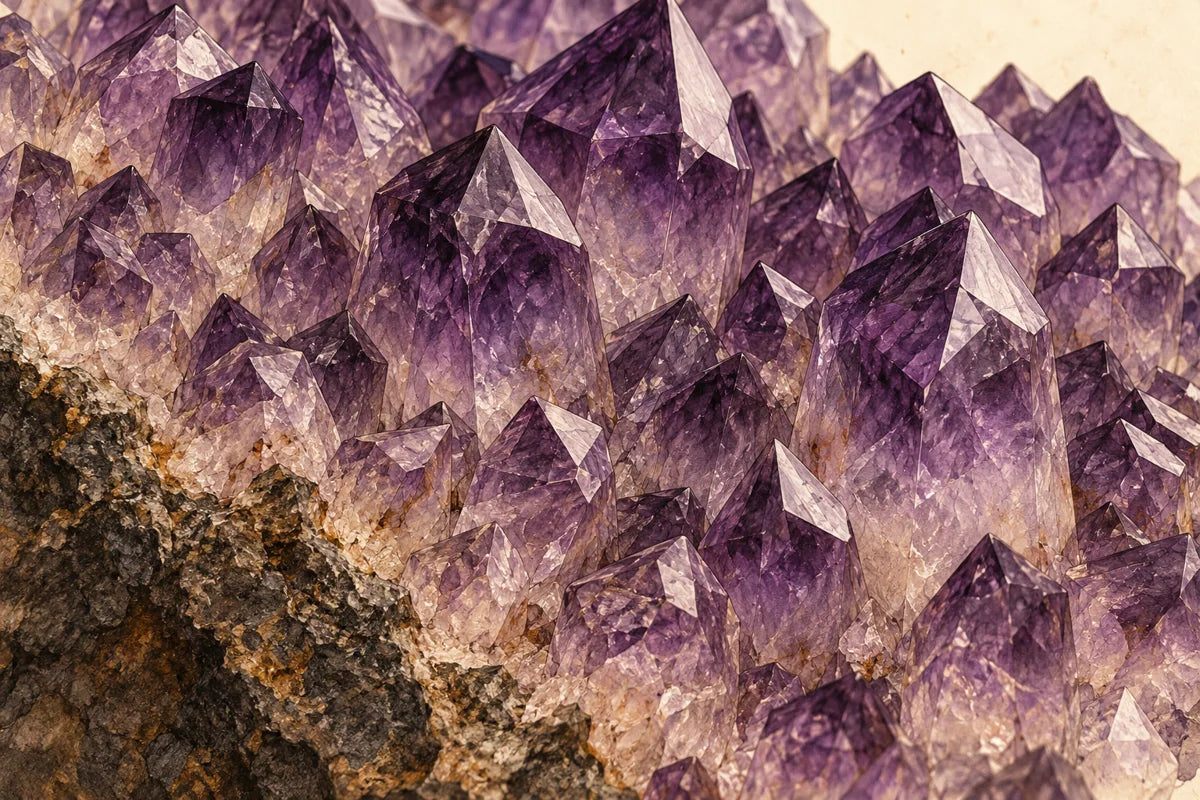
Amethyst is the purple variety of quartz. Its colour can whisper lavender or deepen into violet. Follow it from the inside of a crystal to the meanings, objects and jewellery people make around it.
Some stones are chosen for their colour. Others become companions to a thought, a memory or a moment of change. Amethyst has room for all of them.
Across crystal traditions, its violet depths have gathered stories of reflection, intuition and protection. There is no single way to meet a stone: begin with whatever draws you in.
Amethyst belongs to the quartz family, yet every point, colour band and inclusion gives an individual stone its own character. In crystal culture that individuality becomes part of the relationship we build with it.
Each face catches the light differently, just as another perspective can change the way a question looks.
Amethyst has gathered many associations. These are invitations to reflect, shaped by different traditions and personal experience. A piece worn close can carry a meaning all its own.
Amethyst’s name reaches back to an ancient Greek idea of clear-headedness. In its modern symbolic life, clarity can mean more than having an answer: it can be the room to notice a pattern, turn an assumption around, or choose a considered response.
Let a piece mark the moment you pause before a decision. What changes when you look at the question from another side?
A little distance can change the view.
02 / An inward compass
Intuition
In crystal traditions, violet amethyst is often linked with inner sight and the Third Eye. Think of intuition here as a conversation with your own observations: the small detail, feeling or possibility that asks for a closer look.
Some people keep it nearby while meditating or recording dreams and impressions, returning later to see what still feels meaningful.
Amethyst’s association with quiet makes it a familiar companion for meditation. A piece on a desk or held in your hand can mark a transition from the noise of the day into a few deliberate, unhurried moments.
Notice its particular colour and shape, then give your attention to one breath or one thought. The practice can be as brief as you need.
Stillness is a practice, not a perfect state.
04 / Your own space
Protection
Some crystal practitioners describe amethyst as a protective stone and speak of shielding or clearing unwanted energy. Others connect that idea with the quieter work of recognising their own boundaries.
Worn as jewellery or kept close, a piece can be a personal reminder to notice what you carry, what belongs to someone else, and what you are ready to set down.
In crystal practice, amethyst’s violet is sometimes associated with transmutation: a symbolic turning of difficult energy towards clarity and renewal. Where protection suggests a boundary, transformation offers another possibility: meeting what is already there and choosing how to move forward.
For some, imagining violet light is part of the practice. A piece worn through a time of change can hold a more personal intention, too: a little reminder to meet the next chapter with compassion and a fresh perspective.
Explore the Crown and Third Eye associations, and the ways people choose to work with this stone.
In contemporary crystal practice, amethyst is often connected with meditation, awareness and the movement from a crowded mind towards a wider view. Its violet is part of that language: a colour people return to when they want to reflect, imagine or reconnect with an intention.
Chakra is a Sanskrit word for “wheel.” In Hindu and Buddhist yogic traditions, chakras can describe focal points in a subtle body; different traditions map them in different ways. Explore chakras with the Rubin Museum. The Amethyst pairings here reflect contemporary crystal practice.
Third Eye · inner sight
Often associated with intuition and perception. This connection invites a pause between what is immediately obvious and what you might discover by looking again.
Crown · wider awareness
Often associated with spirituality and connection beyond the everyday. For some, amethyst becomes a companion for contemplation, curiosity and a sense of perspective.
These are spiritual associations, interpreted differently by different writers and practitioners. You might hold a piece while writing, keep it nearby during meditation, or wear it as a reminder of a quality you want to carry with you.
Many contemporary crystal traditions associate it with clarity, reflection, intuition and protection. Writers and practitioners differ, and your own relationship with the stone can be entirely personal.
Why is Amethyst associated with clarity?
Its Greek name is linked to an old belief about intoxication and clear-headedness. The historical belief has developed into a broader contemporary association with perspective and reflection.
Which chakras are associated with Amethyst?
The Crown and Third Eye are common correspondences in contemporary crystal practice. Their meanings are interpreted differently across traditions and writers.
Does a darker Amethyst have a different meaning?
There is no single rule. Violet ranges from pale lavender to deep purple, and people may connect with those shades in different ways. Choose the colour and character that appeal to you.
How can I use Amethyst in a personal ritual?
Keep a piece where you will notice it, wear it as a reminder, or sit with it while you write. Choose a practice and intention that feel meaningful to you.
Geology & varieties
The mineral record
The Essentials
Choose a detail to learn more.
Mineral family · Quartz
What makes it amethyst?
Amethyst is the purple variety of quartz. The same mineral family also includes colourless rock crystal, smoky quartz and citrine: different appearances, but a shared underlying structure.
Quartz is made of silicon and oxygen in a repeating structure. Each silicon atom is surrounded by four oxygens, shared between neighbouring units: that sharing gives the overall ratio of one silicon to two oxygen atoms.
Mohs hardness compares resistance to scratching. Quartz can scratch glass, but a hard stone can still chip or break: hardness and toughness describe different things. Everyday dust can contain quartz too, so gentle cleaning matters.
Quartz belongs to the trigonal crystal system, a classification based on its underlying symmetry. A familiar quartz point can have a six-sided prism: the outward shape and the symmetry used for classification are related, but are not the same description.
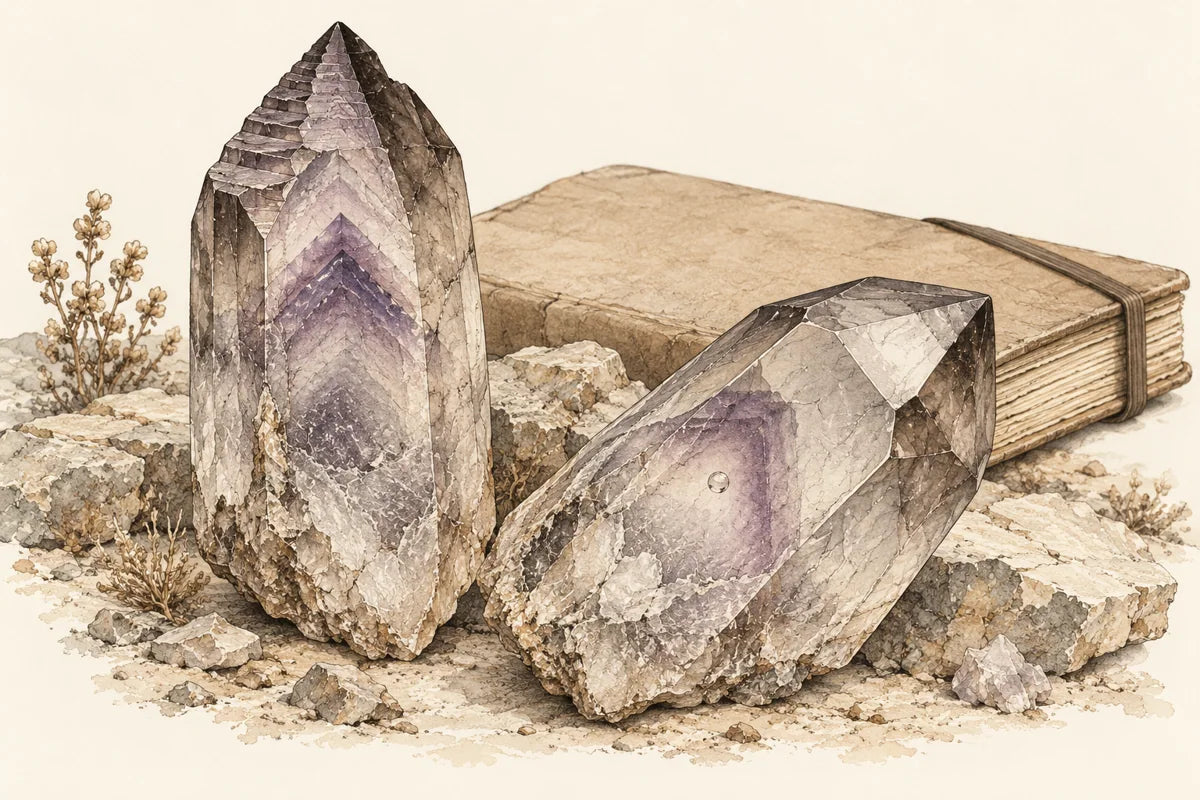
Amethyst's colour is linked to iron in the quartz and exposure to radiation. It can vary from delicate lilac to deep violet, and zones of different colour can record changes as the crystal grew.
Vitreous simply means glass-like. Look for the way light reflects from a clean crystal face or a polished surface; a rough or weathered surface can look different.
A small world in violet. Choose a point on the specimen to discover what gives a crystal its character.
FIELD NOTES ✳
01The point↗
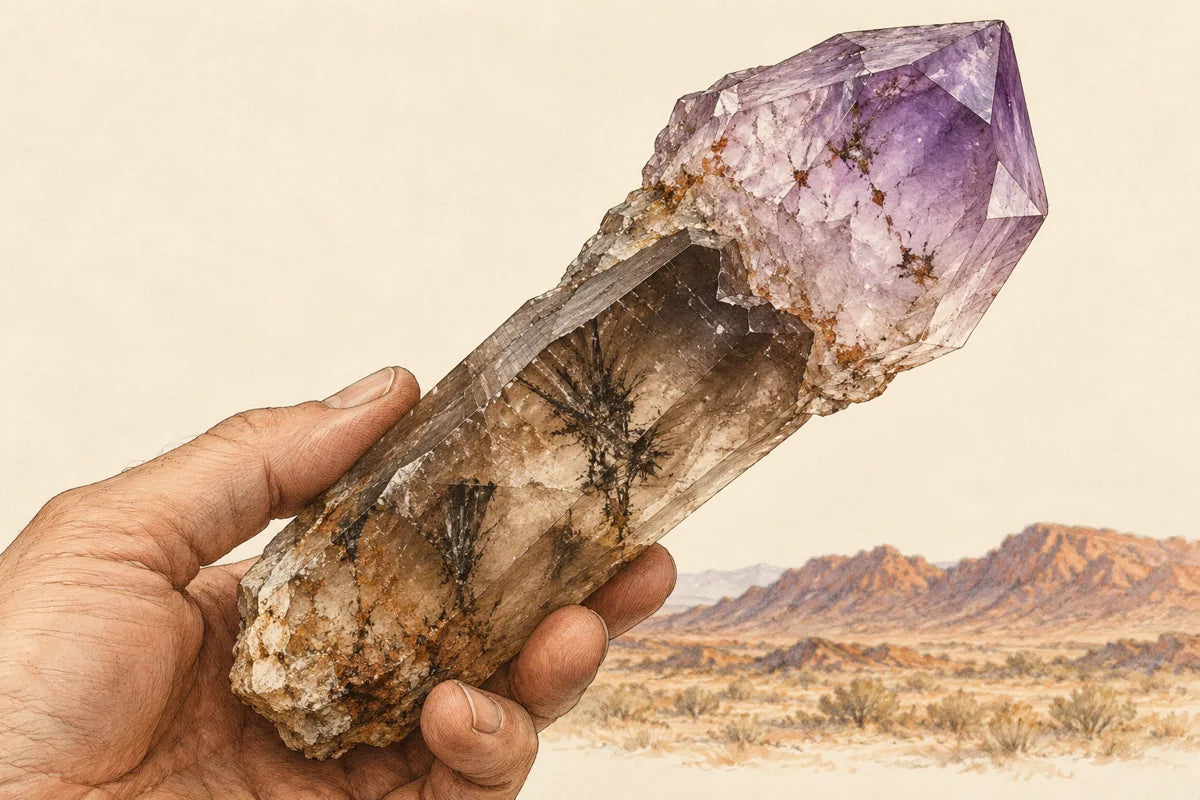
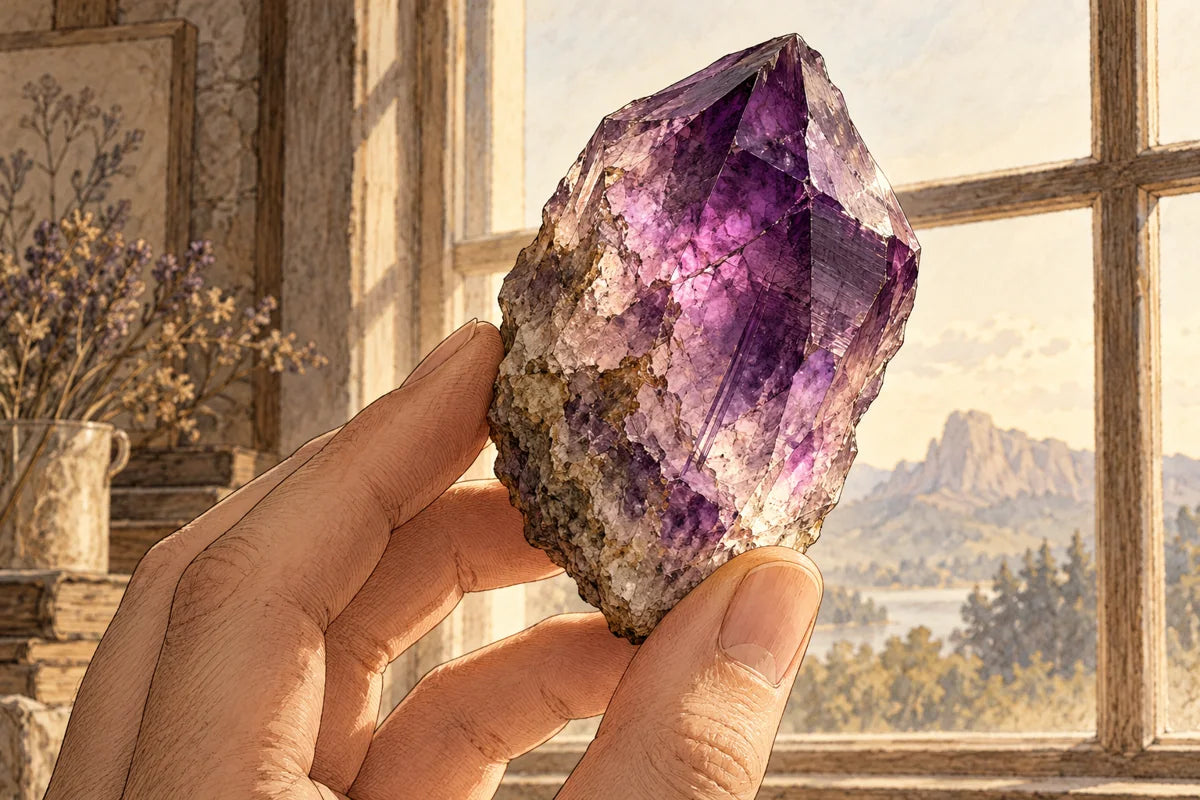
Look at the meeting of the faces. A quartz crystal can grow as a six-sided prism ending in a point, or termination. The exact shape depends on how it grew and the space it had.
Amethyst's colour ranges from pale lilac to deep violet. It is linked to iron within the quartz and exposure to radiation; colour can be unevenly distributed as a crystal grows.
That ghostly outline suggests a phantom: an earlier stage of growth preserved inside a crystal. In quartz, an outline can form when inclusions or changes in colour or clarity mark a former crystal surface.
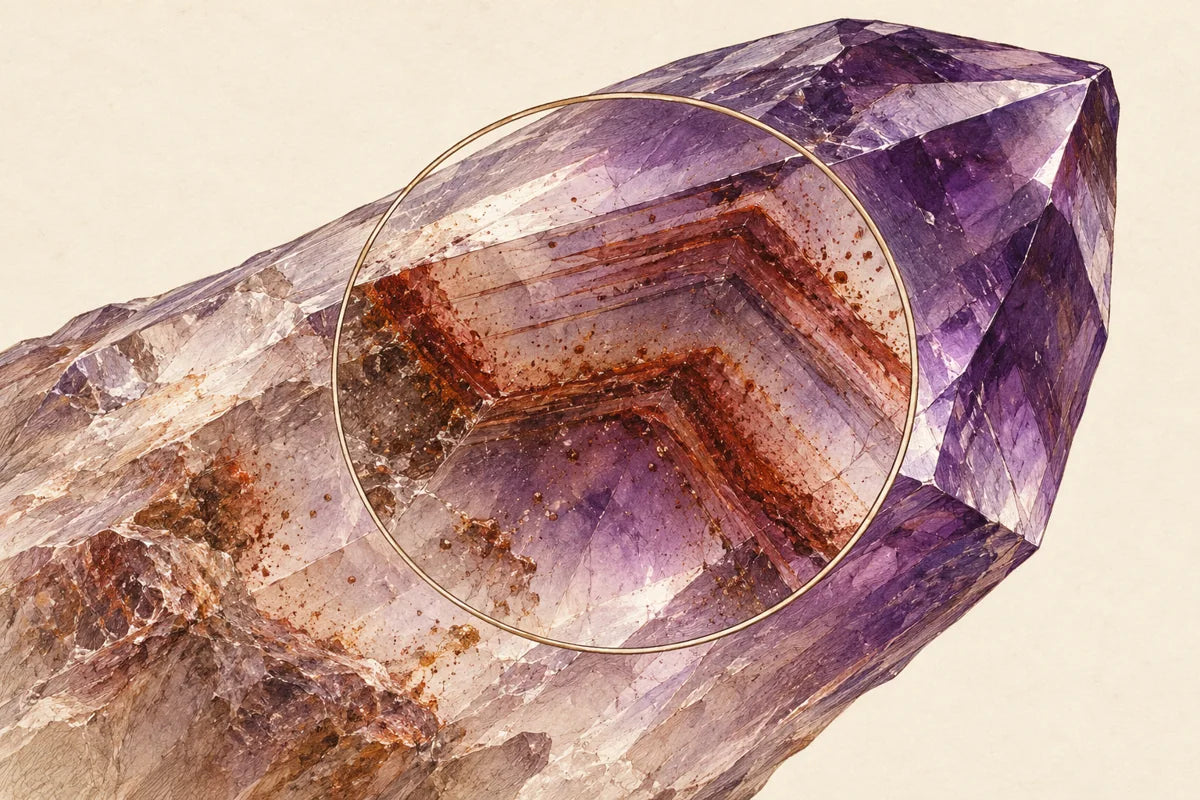
Some quartz holds tiny mineral inclusions or internal fractures, traces of a more complicated history. These features can preserve clues to how a crystal formed.
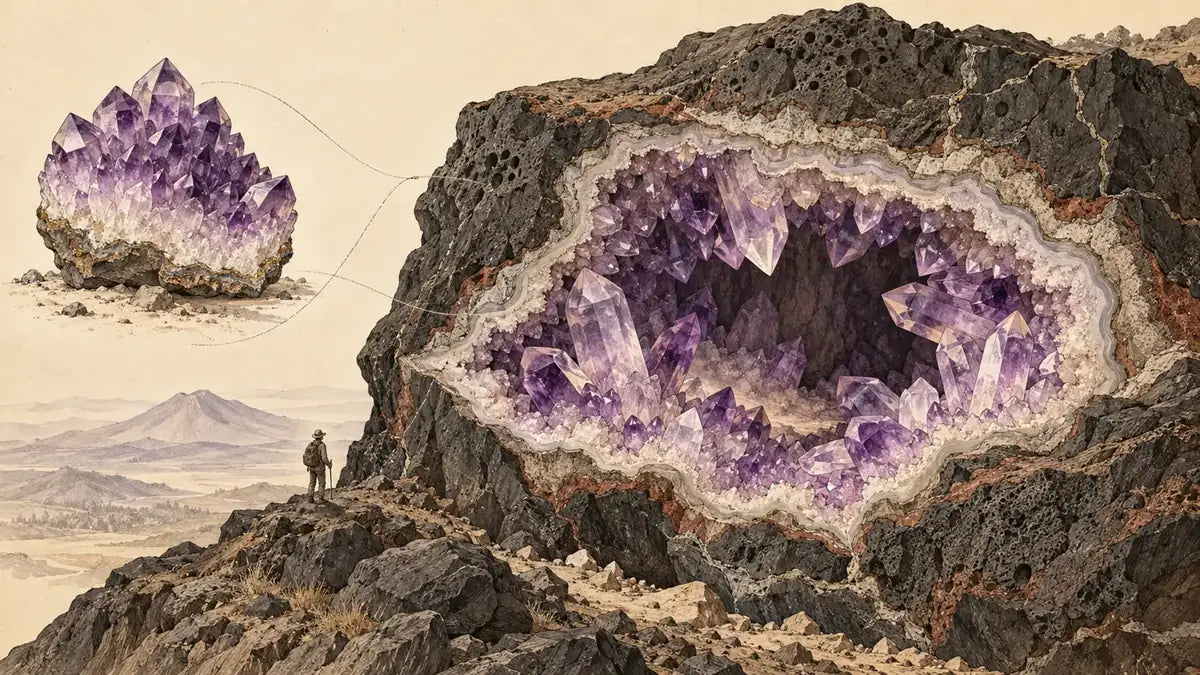
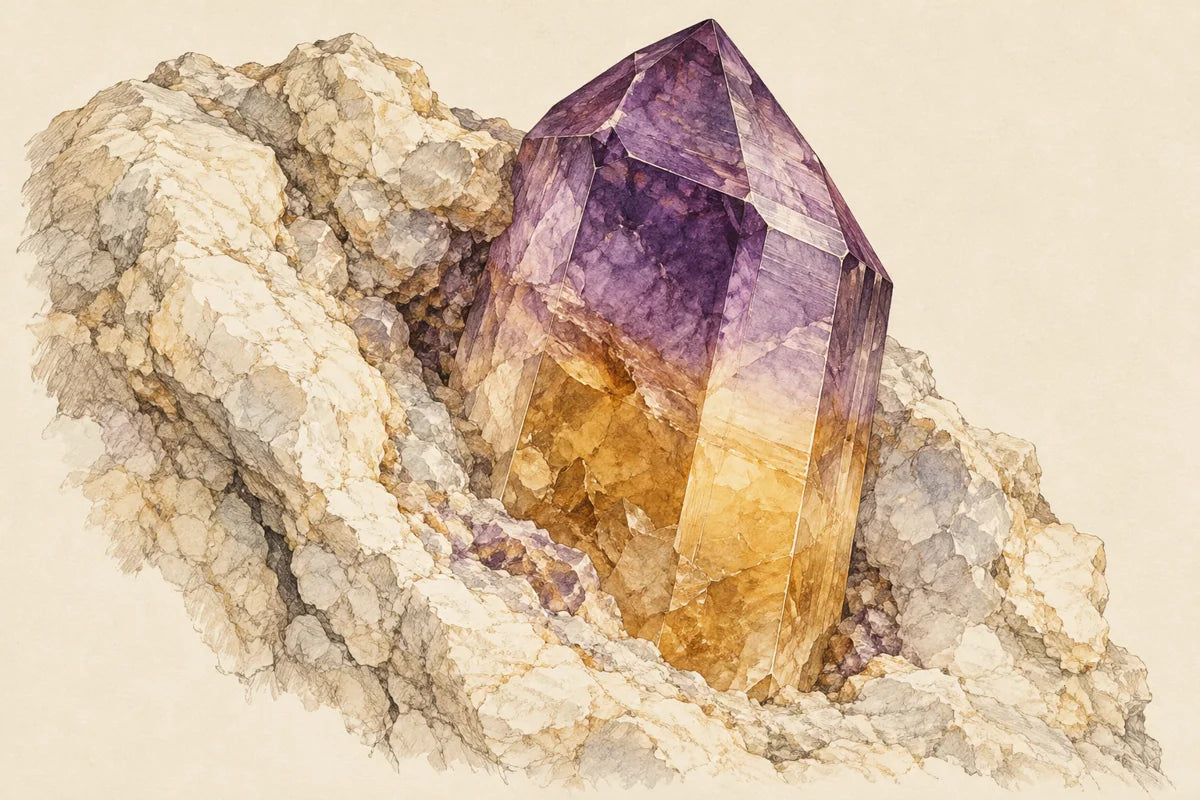
The surrounding material supporting a specimen is called its matrix. Some amethyst grows in crystal-lined volcanic cavities; it also occurs in other geological settings. This illustration does not depict a known locality.
Amethyst begins as quartz, growing slowly from mineral-bearing fluids. In some volcanic rocks, a hollow becomes a sheltered space where crystals can form. Amethyst can also grow in veins and other settings.
A story written in stone · 01—03
Inside the geode.
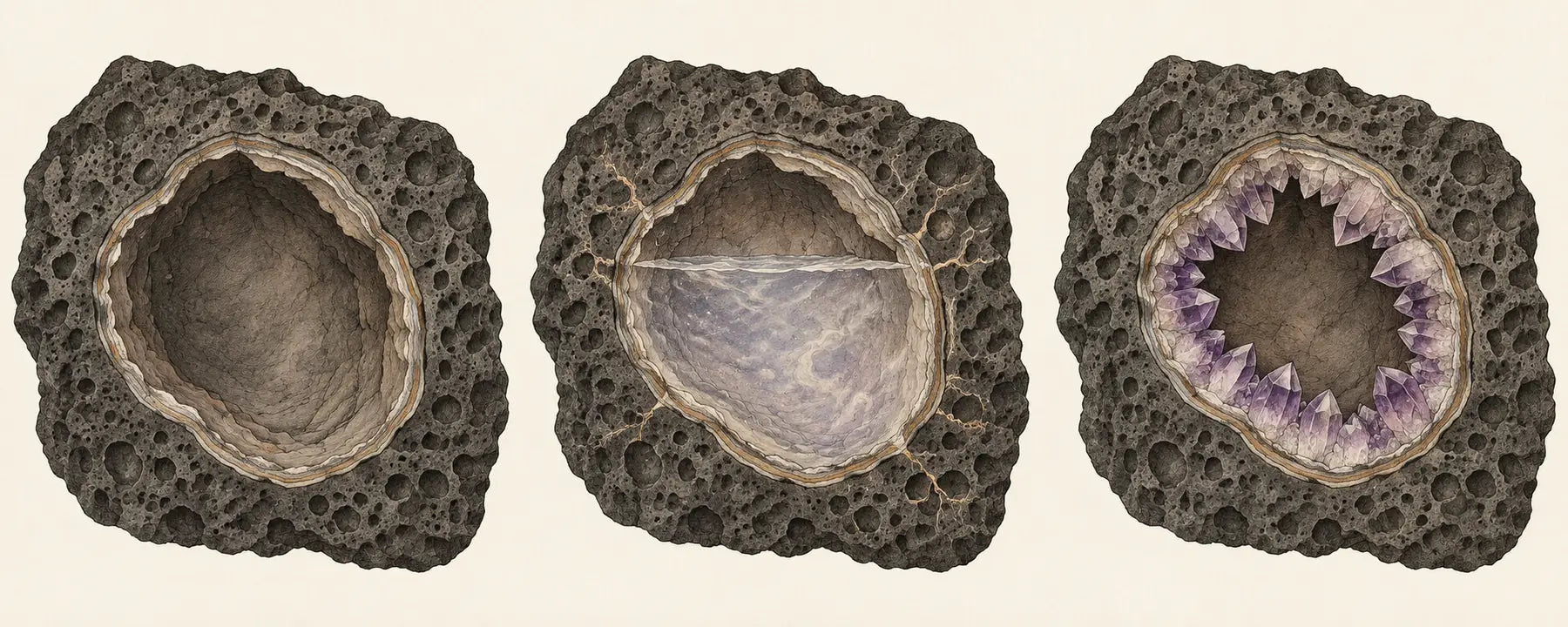
Follow one possible path from a pocket in volcanic rock to a hidden world of quartz.
A journey in three moments
01 / A PLACE TO BEGIN
A pocket in the rock.
When volcanic rock forms, gas bubbles can leave open spaces within it. One of these cavities can become a place where minerals later collect.
The space comes first. The crystals arrive later.
02 / WHAT MOVES THROUGH
A mineral-bearing fluid.
Mineral-rich fluids can reach the cavity through the surrounding rock. As conditions change, dissolved silica becomes available to form quartz.
Mineral-rich fluids can travel through openings in the surrounding rock.
03 / A HIDDEN WORLD
Crystals grow inward.
Quartz can crystallise on the cavity walls, growing towards the open centre. Under suitable conditions, some quartz develops the violet colour we call amethyst.
Not all amethyst forms in geodes: it can also occur in veins and other settings.
A crystal’s shape, colour and setting can give each piece its own presence. Find the details that feel like you, and carry a little of that mineral world with you.
Follow amethyst around the world, and see how its story changes from place to place.
Brazil · Ametista do Sul
Rio Grande do Sul, Brazil
Crystal-lined cavities in ancient basalt
In southern Brazil, amethyst occurs in cavities within volcanic basalt. Some cavities are lined with quartz crystals; others are filled more completely. The region is known for dramatic geodes, but specimens vary greatly in size and form.
Look for Crystal-lined cavities, fine agate bands and clusters.
Veracruz amethyst is often admired for long, clear to pale-violet prisms, sometimes with deeper colour near the termination. Many classic specimens sold as ‘Las Vigas’ come from the neighbouring Piedra Parada area, rather than the town itself.
Look for Elongated crystals, open clusters and purple tips.
Quartz from the Brandberg area can contain smoky and violet zones, phantoms, unusual terminations and fluid inclusions. Much material sold as Brandberg comes from the nearby Goboboseb Mountains; the region’s specimens are varied, and an exact find spot should be kept with the stone.
Look for Smoky and violet phantoms, sceptres and fluid inclusions.
In the Harts Range, some quartz specimens bring smoky, amethyst and paler zones together. Entia Valley is especially associated with sceptre and reverse-sceptre crystals: later growth can form a narrow spire over an earlier smoky point. Each specimen has its own combination of form and colour.
Look for Smoky and violet zones, sceptres and reverse sceptres.
Setting Quartz–calcite veins in the central ranges
The Los Catalanes district in northern Uruguay is recognised for amethyst-bearing geodes in volcanic rock, including exceptionally large examples. Small crystals can line the interior closely, creating a rich surface of violet points.
Look for Crystal-lined geodes, often with dense small points.
The Anahí mine produces amethyst, citrine and ametrine: quartz with amethyst and citrine colours in the same crystal. The deposit occurs in quartz veins in dolomitic limestone in eastern Bolivia, rather than high in the Andes.
Look for Violet and golden zones in a single crystal.
Zambia is an important source of amethyst, including material from the Kariba mine area. GIA notes that some Zambian material can have a richly saturated raspberry-purple colour; colour and clarity still vary from stone to stone.
Look for Rich violet to raspberry-purple gem material.
Some Thunder Bay amethyst contains concentrations of reddish hematite inclusions, producing striking red-brown layers alongside violet quartz. It is a characteristic found in some specimens, not a rule for every stone from the district.
Look for Violet quartz with occasional red-brown hematite.
Long before a crystal became a piece of jewellery, someone chose it, shaped it and gave it meaning. Follow Amethyst through a few of the objects that carry its story.
Egypt · Middle Kingdom
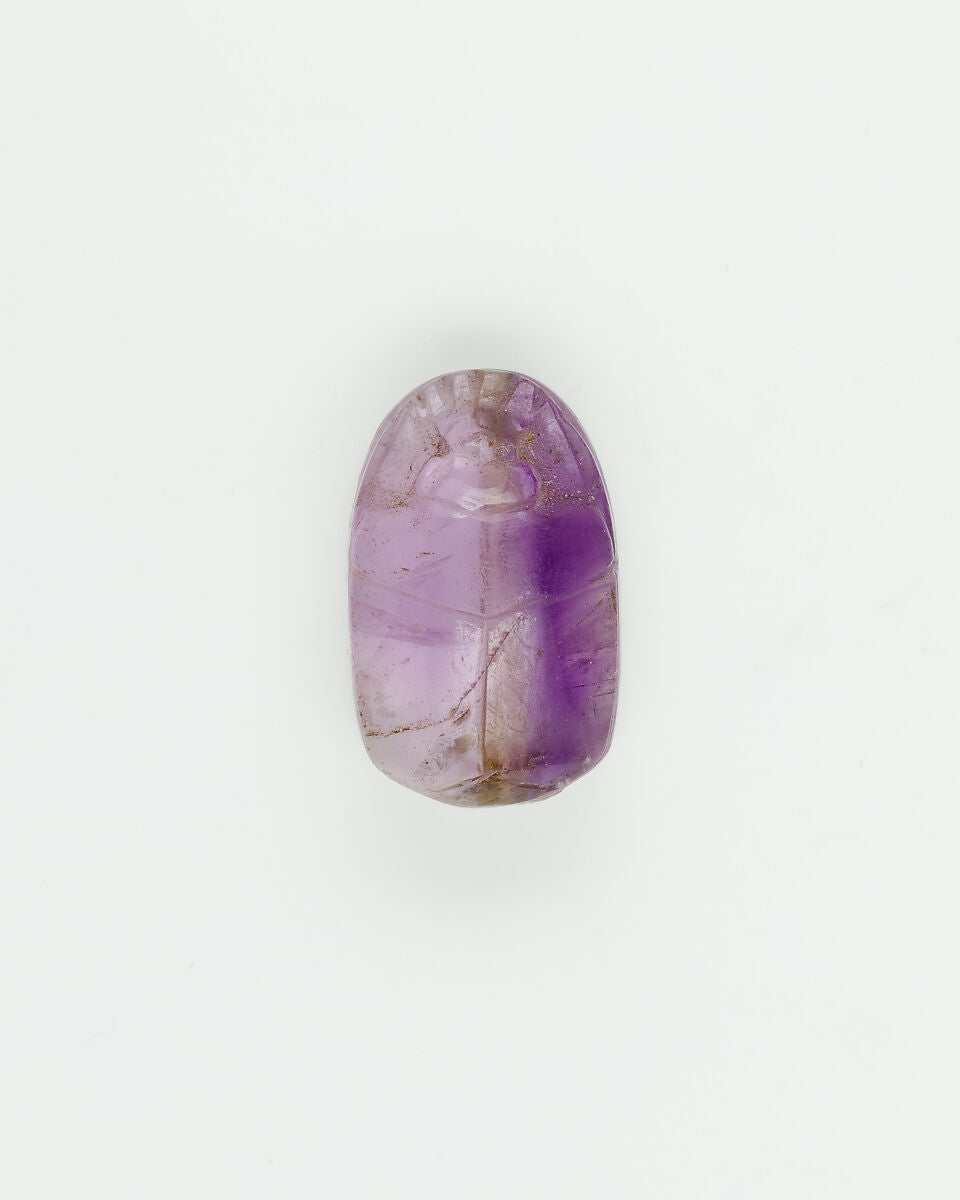
A small amethyst scarab, made nearly four thousand years ago, connects this stone with an Egyptian symbol of creation and renewal.
Its name is related to an ancient Greek word meaning “not intoxicated.” The link reflects an old belief about wine and clear-headedness, a story that travelled with the stone long after the world around it changed.
Its wine-like colour also connects amethyst in gem lore with Dionysus, the Greek god of wine, known to the Romans as Bacchus. A popular tale of wine staining a maiden turned to crystal is a later literary retelling, rather than evidence of an ancient Greek story.
Beliefs, symbols and uses are not the same everywhere. The objects below offer a few real moments in a much larger history.
Look closely at three pieces from The Metropolitan Museum of Art. Their makers used the same violet mineral in strikingly different ways.
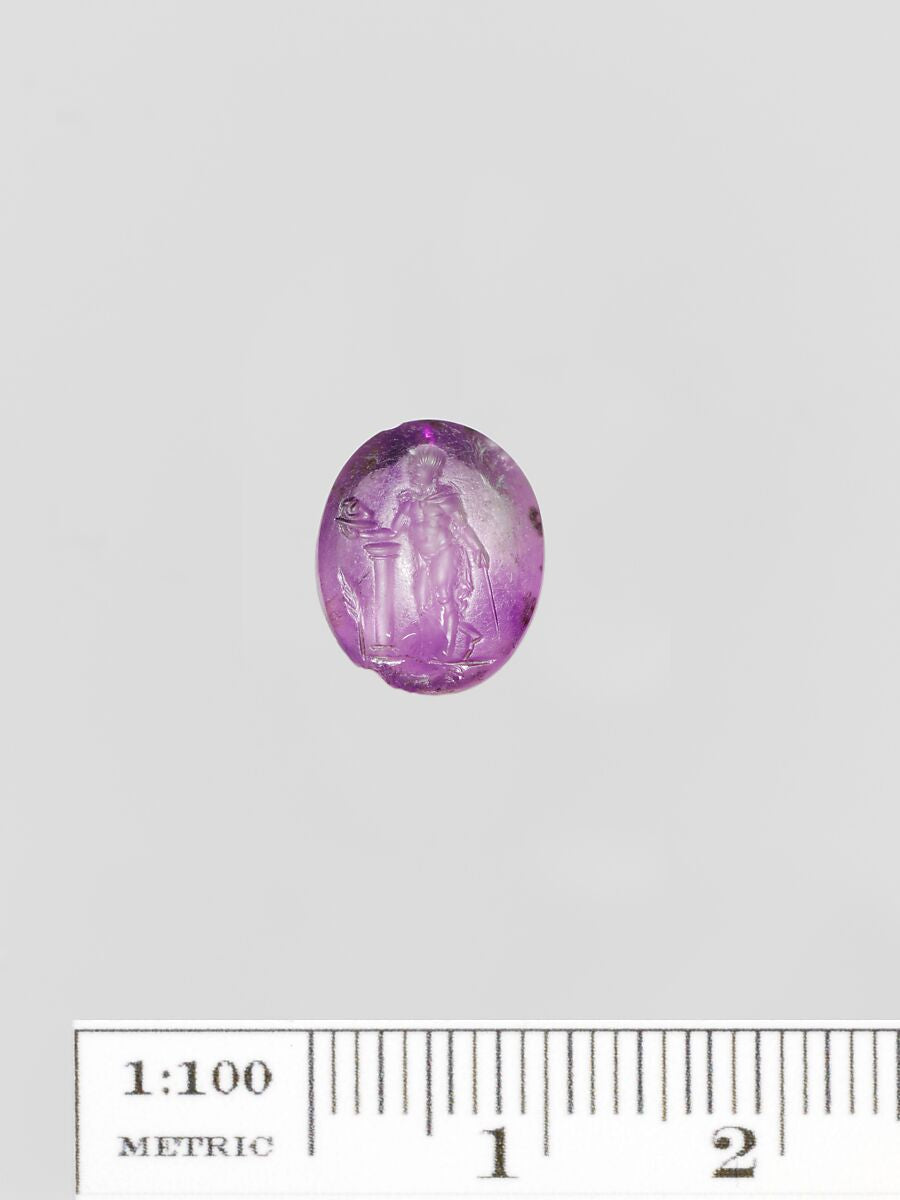
01 / Roman · 1st century BCE–3rd century CE
A story small enough to wear
This engraved ring stone depicts Hermes beside a pillar. At about 1.2 centimetres long, it turns a small piece of amethyst into a remarkably detailed image.
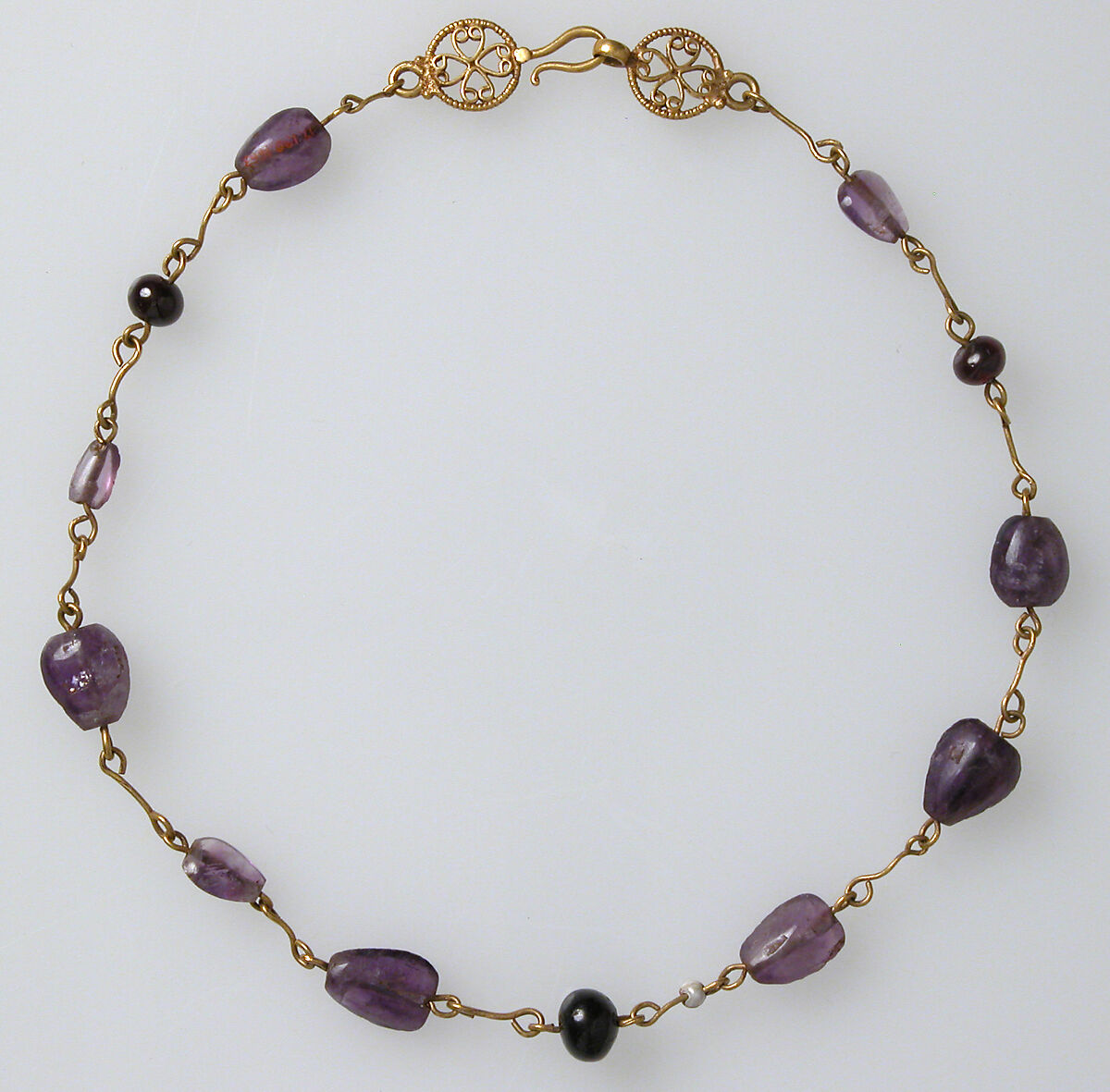
A Byzantine necklace places amethysts along a gold chain with glass beads and a pearl. The arrangement brings together colour and craftsmanship in a piece made to move with its wearer.
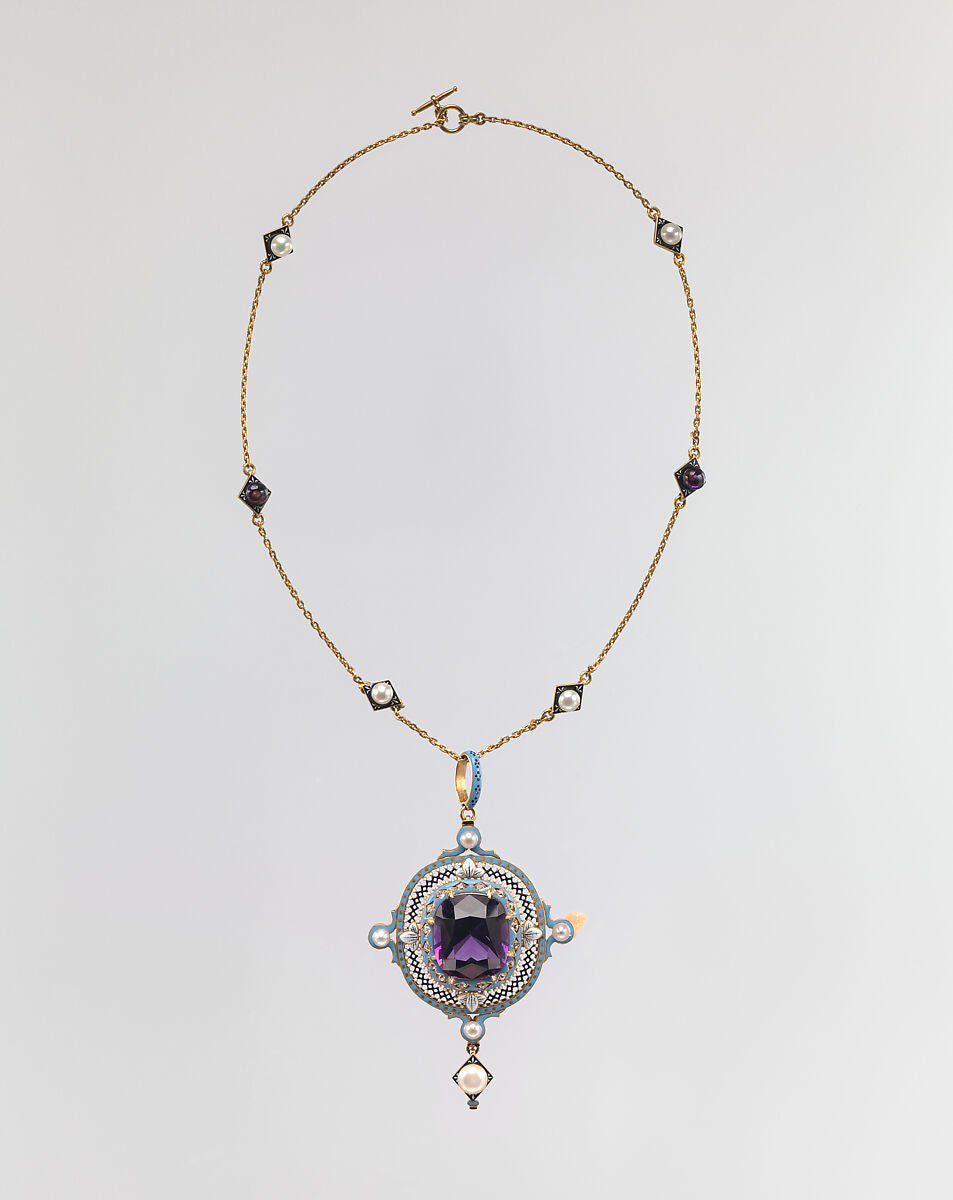
Carlo Giuliano looked to Renaissance jewellery for this pendant, setting an amethyst among gold, enamel and pearls. Its original chain still accompanies it.
The small scarab at the beginning of this chapter was carved from amethyst around 1981–1640 BCE. In ancient Egypt, the scarab was associated with the sun’s journey and ideas of creation and renewal.
Its flat underside is undecorated. The Met notes that its shape and material may have been considered meaningful on their own; an original covering is another possibility. What remains invites us to look closely without pretending to know every detail of its life.
Amethyst has appeared in religious jewellery and royal regalia for centuries. Large Brazilian discoveries in the nineteenth century increased its availability, but the stone continued to inspire makers in many different traditions.
The fascination with violet has not stayed in a museum. A favourite shade, the shape of a stone or the memory attached to a piece can make it personal today.
Birthstones, astrology and crystal traditions offer different ways of connecting a stone with a moment or an intention. Amethyst’s associations vary from one writer to another; these are a few you may encounter.
The number three appears in some numerology-informed crystal writing. Here, “vibration” is a symbolic correspondence within that practice, rather than a measurement of the mineral.
Februarybirthstone
Crown & Third Eyecontemporary crystal associations
Aquarius · Pisces · Virgo · Capricornzodiac associations in some guides
Air & waterelemental associations in our earlier guide
The name is linked to Greek amethystos and a historical belief about intoxication. It is folklore, not a demonstrated effect.
Is Amethyst a birthstone?
Yes. Amethyst is widely recognised as the birthstone for February.
Which zodiac signs are associated with Amethyst?
Aquarius and Pisces appear in our existing guide; some crystal writers also connect Amethyst with Virgo and Capricorn. Other associations exist, and you need not belong to any sign to enjoy it.
Why do some crystal guides connect Amethyst with the number 3?
Some numerology-informed crystal traditions assign Amethyst the number three as a symbolic correspondence. Numerology gives numbers interpretive meanings, and writers may use different systems or associations.
A faceted flash, a raw point, a quiet violet detail. Amethyst takes on a different character in every piece, and the best one is the one you want to reach for.
Notice where the metal meets the stone, the depth of the violet and the way the piece sits when worn. The individual shape and inclusions can be part of its appeal.
Open a piece to see its own photographs, dimensions and available details. If something matters to your choice and it is not listed, ask us.
Amethyst is quartz, with a hardness of 7 on the Mohs scale. That describes resistance to scratching. A sharp knock can still damage a crystal tip or edge.
Start with the whole piece: its stones, metal, finish and setting.
Warm soapy water suits amethyst itself. Avoid steam and sudden changes of temperature. Check the other materials before cleaning a mixed-stone piece.
Where should it rest between wears?
Keep its colour
Some amethyst fades under prolonged intense light. Choose a shaded home for it when you are not wearing it, away from sustained sunlight and heat.
Does hardness mean it cannot chip?
Protect the point
Tips, edges and exposed stones need room. Take jewellery off for rough work and store pieces separately to limit knocks and rubbing.
What else is part of your jewellery?
Check the whole piece
Care for its most delicate material. Pearls, opals, other gems and plated finishes can change the cleaning advice. If you are unsure, ask us about your piece.
Made to be worn
Questions about the jewellery
Can Amethyst be worn in a ring?
Yes, with sensible care. Consider the setting and remove it for activities likely to cause a hard knock.
Are pale and deep-purple pieces the same mineral?
Both can be Amethyst. Its colour ranges from soft lavender to deeper purple, and a single crystal can show more than one shade.
Does colour tell me where a stone came from?
No. Colour alone cannot establish origin, natural or laboratory growth, or treatment. Ask about the information available for an individual piece.
Do I need a February birthday to wear Amethyst?
Not at all. It is widely recognised as February’s birthstone, but it can be chosen for its colour, character or a meaning that is personal to you.
FROM THE EARTH TO YOUR EVERYDAY
Amethyst, made personal.
From delicate violet glimmers to expressive crystal forms, every piece carries its own character. Explore the collection and find the stone and setting that feel like yours.
This is a limited oxidized 925 sterling silver pendant featuring a rare Vera Cruz Amethyst point and eye-shaped faceted Emerald, with an open Brutalist wire sphere and dark sculptural silver finish, designed as a vision talisman for heart clarity, intuition, and spiritual focus. Jewelry...
Amethyst and Aquamarine Adjustable Ring A polished sterling silver adjustable ring set with two Amethysts and one Aquamarine, made for calm, clarity, and balanced emotional flow. Key Details: - Metal Details: Solid 925 sterling silver with a polished shiny finish - Stone Details: Two...